

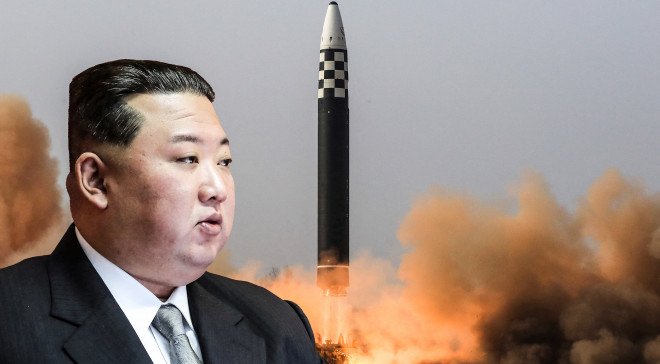
North Korea has again presented its nuclear weapons program as a central element of national security, arguing that its nuclear capabilities are necessary to protect the country’s sovereignty amid continued tensions with the United States and its allies.
The statement comes as Pyongyang continues to reject international demands that it abandon its nuclear weapons and ballistic missile programs.
Garowe Online reported on August 31 that North Korea described its nuclear weapons as a shield for its sovereignty, while noting that the United States has consistently called on Pyongyang to give up its nuclear and missile programs.
Nuclear Weapons at the Center of Security Policy
North Korea has for years argued that its nuclear arsenal is primarily defensive.
The government in Pyongyang maintains that military pressure from the United States and South Korea represents an existential threat and that nuclear weapons are therefore necessary to deter a potential attack.
Washington, however, has taken the opposite position, arguing that North Korea’s nuclear and missile programs threaten regional and international security.
The disagreement has created one of the world’s longest-running nuclear security disputes.
Tensions With the United States
Relations between North Korea and the United States remain heavily influenced by disagreements over denuclearization.
Washington has repeatedly sought a reduction and eventual elimination of North Korea’s nuclear capabilities. Pyongyang, meanwhile, has shown little willingness to surrender a program it considers essential to its survival.
The result has been a cycle of military pressure, diplomatic negotiations and renewed tensions.
The nuclear issue is also closely linked to North Korea’s relations with South Korea and Japan, both of which remain deeply concerned about Pyongyang’s military capabilities.
Regional Security Concerns
North Korea’s nuclear policy has consequences beyond the Korean Peninsula.
Japan and South Korea closely monitor developments in Pyongyang because North Korean missile systems are capable of reaching targets across the region.
Any new escalation could therefore trigger stronger military cooperation among the United States, South Korea and Japan.
At the same time, North Korea has continued developing its military capabilities, making the prospect of a rapid return to negotiations increasingly complicated.
Diplomacy Remains Difficult
The fundamental disagreement between Pyongyang and Washington remains unresolved.
North Korea wants recognition of its security concerns and acceptance of its strategic military capabilities, while the United States continues to push for denuclearization.
Finding common ground between these positions will be difficult.
For now, North Korea’s latest position reinforces the importance it places on its nuclear arsenal and suggests that the country is unlikely to make major concessions without significant changes in its security environment.